
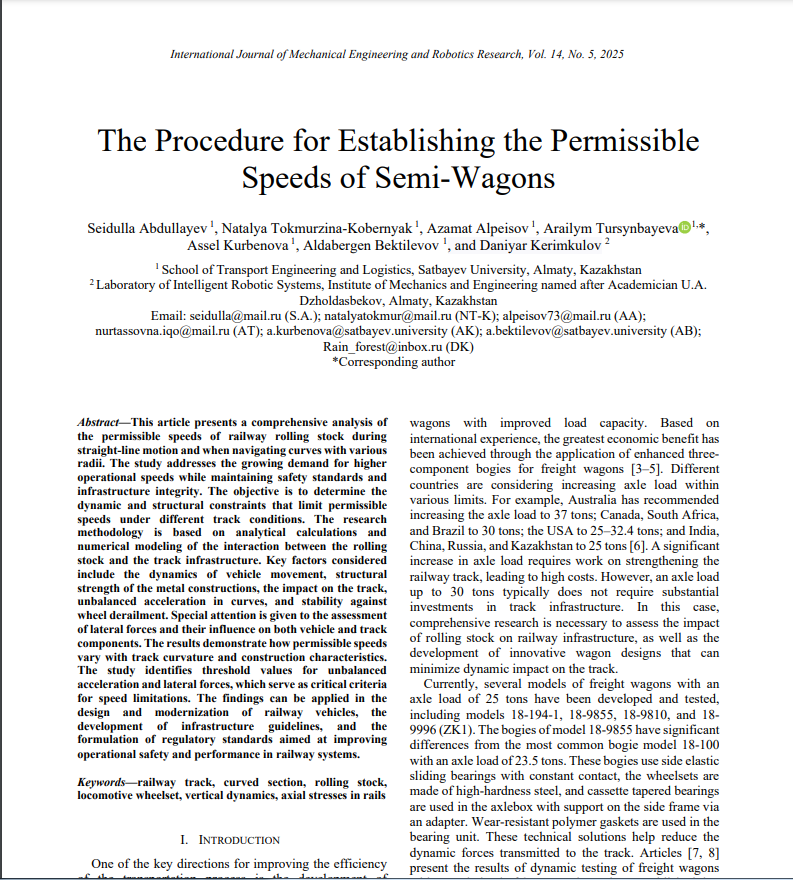
This article presents a comprehensive analysis of the permissible speeds of railway rolling stock during straight-line motion and when navigating curves with various radii. The study addresses the growing demand for higher operational speeds while maintaining safety standards and infrastructure integrity. The objective is to determine the dynamic and structural constraints that limit permissible speeds under different track conditions. The research methodology is based on analytical calculations and numerical modeling of the interaction between the rolling stock and the track infrastructure. Key factors considered include the dynamics of vehicle movement, structural strength of the metal constructions, the impact on the track, unbalanced acceleration in curves, and stability against wheel derailment. Special attention is given to the assessment of lateral forces and their influence on both vehicle and track components. The results demonstrate how permissible speeds vary with track curvature and construction characteristics. The study identifies threshold values for unbalanced acceleration and lateral forces, which serve as critical criteria for speed limitations. The findings can be applied in the design and modernization of railway vehicles, the development of infrastructure guidelines, and the formulation of regulatory standards aimed at improving operational safety and performance in railway systems

The SX-EW technology is more effective for the production of copper from refractory oxidized ores for the present day. A wide range of modern extractants is currently offered on the market for the extraction of copper from leaching solutions and its choice is a very important issue in the production of copper using the SX-EW technology. The aim of this work was to study the extraction properties of modified extractants of the Acorga series (5747, 5910, 5640) and unmodified extractant Lix 984N. It has been established that extractants Acorga 5640 and unmodified Lix984 have high selectivity to copper. During the extraction of copper from the productive solution with the use of all extractants, the formation of a third phase, cruda, is observed. Physical and chemical studies have established that the steak contains a large amount of silica, magnetite, hematite and anglesite. The distribution of iron, silica, and copper ions during extraction was studied and it was found that the extractant Lix 984N (10%), then Acorga5640 (10%), has a high selectivity to copper/iron and copper/silica. Acorga 5640 (10%) is an effective extractant of copper from the productive solution of the Almaly deposit. It is observed that the amount of crud formed during extraction also depends on the rate of phase mixing, the number of revolutions of the stirrer, at a speed of 350-450 rpm, the formation of crud is 0.73%. The addition of the Acorga CR60 reagent in the amount of 5-10 ppm leads to a 3-3.2-fold decrease in the volume of the crud

This study proposes a novel computational method, employing the integral dynamics of multibody systems to simulate the transverse vibrations of the rotor in a cantilever-type centrifugal pump. This method was applied to the kinematic assembly of the rotor and its supports, with the latter modeled as springs possessing stiffness and damping properties equivalent to those of real bearings supporting the shaft in an actual design. To investigate transverse vibrations within the system, three key observation points were defined—at the locations of the left and right bearings, as well as at the rotor’s center of mass—to allow for a thorough dynamic analysis. Additionally, the influence of motor rotational speed and the impeller’s eccentricity on the transverse vibrations of the supports and the shaft was examined. The results have revealed that transverse vibrations significantly affect the system’s dynamics at lower rotational speeds, leading to the classification of the shaft as flexible. As the rotational speed increases, the system exhibits enhanced dynamic stability. Furthermore, it was found that for impellers with a diameter less than 300 mm, the unbalanced forces are negligible and can be disregarded in pump design. To reduce vibration levels, an elastic damping ring was selected and incorporated into the system. This novel method provides an effective tool for analyzing the transverse vibrations of centrifugal pump rotors and for optimizing vibration mitigation strategies. © 2025 by the authors.

Niobium commonly occurs as a minor component in Fe–Ti–O oxide systems associated with ilmenite ores and titanium-bearing metallurgical materials, yet its speciation and incorporation mechanisms remain insufficiently resolved. This study investigates the distribution, structural incorporation, and microphase localization of niobium in the Fe–Ti–O system, with emphasis on TiO2-rich domains. Electron probe microanalysis with EDS/WDS, Xray diffraction, thermal analysis, and thermodynamic modeling in HSC Chemistry were combined to characterize niobium-bearing phases in natural and model oxide systems. Niobium was found to occur in two principal modes: as a low-level isomorphic impurity in Fe–Ti oxide matrices and as localized enrichments in TiO2-rich domains, particularly rutile lamellae. A first-order area-based estimate for representative analyzed grains suggests that approximately 60–80% of the detected niobium is associated with the lamellar TiO2 channel. The combined observations are consistent with a sequential mechanism involving isomorphic substitution of Nb in Ti sites, followed by microphase enrichment and segregation into more compositionally distinct niobium-bearing oxide or titanate microphases. In the studied material, integrated mapped-field Nb is about 0.04 wt.%, whereas matrix Nb commonly lies at trace levels of about 0.02–0.05 wt.% under the applied analytical conditions, consistent with low-level background incorporation, whereas locally Nb-enriched rutile-like domains reach about 0.70–1.00 wt.%. TiO2-rich domains are therefore identified as the principal concentrators of niobium in Fe–Ti oxide systems. Taken together, the natural observations, model experiments, and thermodynamic calculations support an integrated mechanistic sequence of Nb evolution in the Fe–Ti–O system: isomorphic substitution→microphase enrichment in TiO2-related domains→segregation into distinct Nb-bearing oxides/niobates. These findings provide a practical framework for interpreting Nb behavior in natural and technological Fe–Ti–O materials

This study explores the synthesis of sorption-active phosphate materials from manganese ore enrichment tailings of the Zhairem deposit. The initial tailings, predominantly composed of calcite (76.4 %), quartz (16.4 %), and braunite, were characterized by XRD and EPMA. Acid-thermal treatment with phosphoric acid followed by calcination at 200-800°C yielded calcium - manganese phosphate materials. Phase transformations were monitored via XRD, showing formation of crystalline phosphates at 200 - 600°C and a glassy phase at 800°C. The product synthesized at 600°C demonstrated the lowest water solubility (9.91 %), highest pore volume (0.175 cm³ g-1), and optimal sorption capacity for Ni2+ (0.2934 mg-eq g-1), which increased to 0.4697 mg-eq g-1 after 0.4 wt. % of HCl activation. The enhanced performance is attributed to the formation of low-solubility polyphosphates and well-developed porous structures. SEM confirmed porous morphology at 600°C and denser, glassy structure at 800°C. The synthesized material showed no toxic elements such as Pb, Cd, or As, making it suitable for environmental applications. The findings indicate that Zhairem tailings are a promising raw material for producing effective sorbents for heavy metal removal, especially after acid activation. The optimal product is the calcium-manganese phosphate synthesized at 600°C.

Water and soil resources are one of the most important natural resources of a country, from which all the food needs of humans and animals are provided, but unfortunately, they are constantly exposed to encroachment and changes by human and non-human factors. Biochar is one of the solutions recently considered in international scientific forums for soil and water protection. In this study, carbon adsorbents' performance has been investigated to remove heavy metal pollutants. Carbon adsorbents, unlike resins that only deal with ion exchange, work in different environments, including in the presence of carboxyl, imidazole, sulfhydryl, amine, sulfate, phosphate, thioether, phenol, carbonyl, amide, and hydroxyl bases. In this study, the absorption rate of heavy trace elements with carbon adsorption and their efficiency has been investigated, and the results of pH and optimal concentration for carbon adsorption have been presented. A study has been done on the carbon absorbents used to separate heavy metals. Bio-carbon adsorbents are a cheaper and more effective alternative to separate metals and metal elements, especially in the separation of heavy metals in soil treatment. In this study, the amount of absorption in bio-absorbents, according to the cell structure and their types, has been investigated. The results show that the subsequent adsorption of bio-carbon adsorbent can be a suitable method for purifying soil from heavy metal ions.

Single-phase ground faults (SPGFs) in isolated neutral medium-voltage networks are difficult to detect, especially under high transient resistance. This paper proposes a centralized ground fault protection unit (CGFPU) that combines zero-sequence current (ZSC) magnitude and phase-angle analysis to enhance selectivity. Simulation results show that as transient resistance increases from 1 Ohm to 10 kOhm, fault currents decrease significantly, yet the CGFPU reliably identifies the faulty feeder by exploiting the characteristic 180° phase shift of ZSC phasors. The method remains selective with angular deviations up to ±20° and distinguishes between feeder and busbar faults. Compared with conventional amplitude- or model-based techniques, the proposed approach achieves faster detection, lower computational complexity, and robustness against unbalanced and charging currents. Furthermore, the CGFPU operates adaptively in alarm or trip mode depending on fault severity, thus preserving continuity for high-resistance faults and ensuring rapid isolation of bolted faults. These contributions establish a practical, scalable, and future-ready solution for SPGF protection in medium-voltage isolated neutral networks. © 2025 by the authors.

The current study provides a new leaching method for extracting valuable metals, such as uranium, vanadium, molybdenum, and rare earth metals (REMs), from black shale ores. Initial characterization indicated that these metals are encapsulated in hard “carbon-silica shells,” presenting severe extraction challenges. A novel low-temperature sintering process is considered in this work with ammonium hydrosulfate at 350 °C for 60 minutes, much lower than the conventional process of over 800 °C. The devised treatment effectively ruptures the protective shell, converting metal constituents into soluble forms. Subsequent leaching yielded good recovery rates: uranium (93.3%), vanadium (81.7%), molybdenum (82.2%), and REMs (78.3%). Thermogravimetric analysis revealed the stepwise decomposition mechanism and emission profiles upon sintering. The leaching parameters (solid-liquid ratio, temperature, time, and solution concentration) were optimized for maximum metal recovery, along with selective sorption conditions (pH, redox potential, and duration) and desorption variables. Additionally, the cost-effective production routes for vanadium concentrate were specified as ammonium metavanadate, molybdenum concentrate as calcium molybdate and REM concentrate as carbonates, instead of depending on high-pressure or high-temperature processes. Solid residue carbon flotation enrichment was accompanied by a recovery yield of 89.0% by weight of carbon, enabling enhanced utilization of the entire resource. Altogether, the adopted approaches offer a closed-loop, energy-saving pathway to the efficient recovery of the rare and essential metals from the black shale ore

A new iodine–dextrin–lithium complex (IDLC) was synthesized and structurally characterized as a hybrid supramolecular system combining antiseptic, stabilizing, and biocompatible components. The compound integrates iodine as the primary antimicrobial agent, lithium as a coordination and stabilization element, and dextrin as a biodegradable polysaccharide matrix enabling sustained release. Physicochemical analyses confirmed the formation of a uniform, thermally stable complex. Biological evaluation revealed strong bactericidal activity, with minimum bactericidal concentrations (MBCs) ranging from 1.95 to 15.63 µg mL−1 against both Gram-positive and Gram-negative pathogens, including multidrug-resistant Staphylococcus aureus and Acinetobacter baumannii. Cytotoxicity studies revealed moderate, concentration-dependent effects on human peripheral blood mononuclear cells (CC50 = 0.23–0.48 mg/mL; 11.7–24.4 μg I/mL) and low toxicity toward MDCK cells (CC50 = 10–20 mg/mL; 507–1014 μg I/mL), confirming a favorable safety profile. IDLC exhibited cytotoxic effects on tumor cell lines (HepG2, HeLa, AGS, K562, and H9) as well as on the normal MeT-5A cell line; however, the CC50 values are similar, and selectivity indices are close to 1, indicating no selective cytotoxicity toward tumor cells. Thus, IDLC demonstrates non-specific cytotoxicity at high concentrations, consistent with its iodine content. The research confirms that iodine can be effectively stabilized within a dextrin-lithium framework to yield a biologically active, thermally resistant complex, suitable for pharmaceutical use.

This paper addresses the problem of synthesizing four-link initial kinematic chains with rotational pairs for designing flat lever mechanisms with specified motion laws of the input and output links. The proposed method formulates the synthesis problem as an optimization process involving three moving planes Q, Q1 and Q2. Each plane performs distinct motions: Q is fixed, Q1 rotates around a point A, and Q2 undergoes plane-parallel motion. The goal is to determine the optimal position of point A ∈Q, B ∈Q1 and C ∈Q2 such that the distance between points B and C remains nearly constant across multiple configurations. The synthesis problem is reduced to a sequence of linear systems of equations corresponding to three iterative minimization stages: Determining the fixed-point A and the radius R for given points B and C; Determining the point B and radius R for a given point C; Determining the point C and radius R for a given point B. The algorithm uses a hierarchical optimization process to iteratively refine the positions of A, B, and C until convergence is achieved. The convergence criteria are defined by the small changes in the positions of these points and the radius R between iterations. The proposed method avoids solving a highly nonlinear system directly by decomposing the problem into simpler linear systems, ensuring computational efficiency and robustness. The solution provides the desired positions of the points, forming an open kinematic chain ABCD with three degrees of freedom. The approach is applicable to the synthesis of complex planar mechanisms with unrestricted parameters, making it a valuable tool for mechanism design. © The Author(s) 2026. This article is licensed under a Creative Commons Attribution NonCommercial-NoDerivatives 4.0 International, which permits the use, sharing, adaptation, distribution and reproduction in any medium or format, as long as appropriate credit to the original author(s) and the source is given by providing a link to the Creative Commons license. https://creativecommons.org/licenses/by-nc-nd/4.0/.
Показано 751–760 из 3424