
Авторы:
Издательство:
Дата издания
08.09.2025На каком языке издана
Область исследования
Тип исследования
Аннотация (краткое описание)
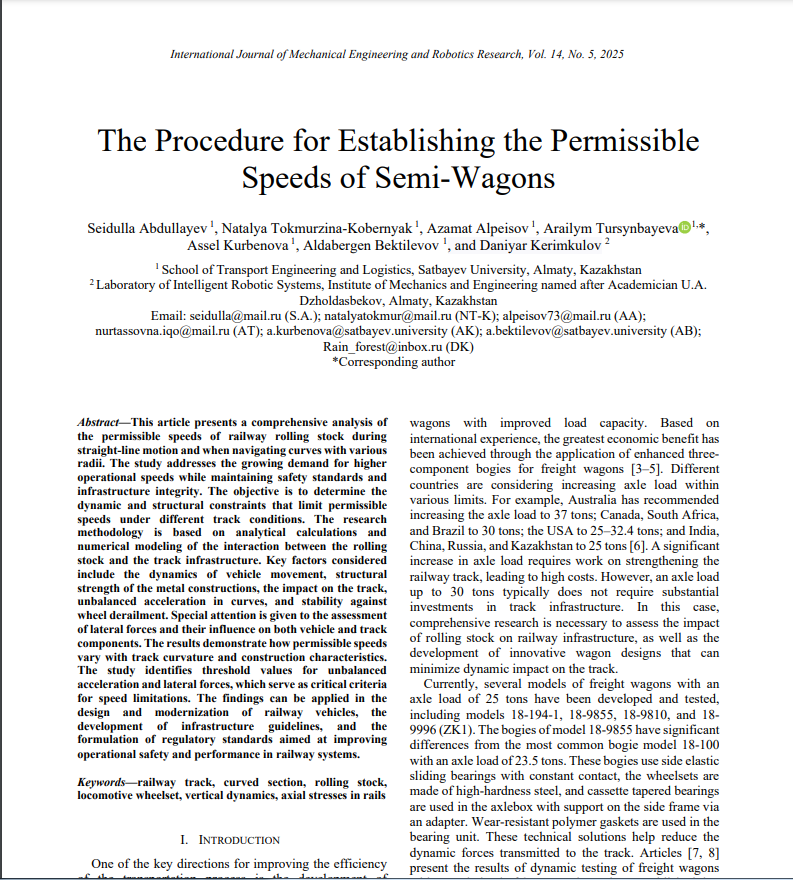
This article presents a comprehensive analysis of the permissible speeds of railway rolling stock during straight-line motion and when navigating curves with various radii. The study addresses the growing demand for higher operational speeds while maintaining safety standards and infrastructure integrity. The objective is to determine the dynamic and structural constraints that limit permissible speeds under different track conditions. The research methodology is based on analytical calculations and numerical modeling of the interaction between the rolling stock and the track infrastructure. Key factors considered include the dynamics of vehicle movement, structural strength of the metal constructions, the impact on the track, unbalanced acceleration in curves, and stability against wheel derailment. Special attention is given to the assessment of lateral forces and their influence on both vehicle and track components. The results demonstrate how permissible speeds vary with track curvature and construction characteristics. The study identifies threshold values for unbalanced acceleration and lateral forces, which serve as critical criteria for speed limitations. The findings can be applied in the design and modernization of railway vehicles, the development of infrastructure guidelines, and the formulation of regulatory standards aimed at improving operational safety and performance in railway systemsDOI
10.18178/ijmerr.14.5.487-499Тип публикаций
Практическое значение
The development of heavy freight traffic in Kazakhstan poses challenges for increasing axle loads. In this context, the introduction of cars with increased load capacity requires research aimed at establishing safe operating conditions for rolling stock and ensuring the stability of the railway infrastructure [35]. During the dynamic testing of flatcars, dynamic indicators were assessed, including the vertical dynamic coefficient, wheel stability against derailment, and the lateral and vertical forces acting from the wheel on the rail. It was determined that the maximum values of the dynamic indicators do not exceed the normative permissible levels when operating on a standard track.Данный документ располагается в коллекциях
Научные издания SU
Файлы документа
IJMERR-V14N5-487 (1).pdf